
Manjit, EKTA, and the Migrant Experience
Posted on
"Poverty in the migrant community has to be understood differently to poverty in the local community.”
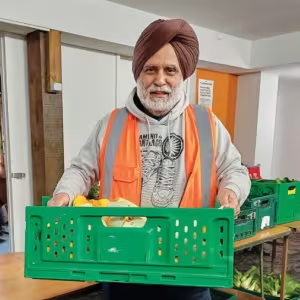
MANJIT GREWAL’s favourite part of volunteering is knowing that he has a purpose. He does not treat volunteering as a hobby; he is acutely aware of his social responsibility and would encourage others to approach volunteering in the same way. Manjit grew up in an incredibly multicultural society, which allowed for a diverse mix of religions and people to coexist. He believes that “differences should be … a point of recognition and acceptance.”
Manjit and his wife, Geetha, originally from Malaysia, arrived in New Zealand in 1976, where he completed a post-graduate degree at Victoria University in 1979. Afterwards, they relocated to Singapore, where Manjit worked for Singapore Airlines. However, the relocation between different countries did not provide the stability the family needed, and Geetha and the children moved to New Zealand. It wasn’t until 2013 that Manjit was able to join them after retiring. Now, Manjit and his wife have time, experience, knowledge, and a desire to give back to their chosen home.
Manjit established the charity EKTA – meaning unity and oneness – in 2017. EKTA focuses on, primarily Indian, new migrants to New Zealand, empowering them with the skills and understanding to navigate New Zealand society. During COVID, they helped students and visitors who were stuck in the country, ensuring they were safe, fed, and not forgotten by the system.
From there, EKTA developed into food distribution. Since 2019, they have been distributing from St Peter’s church, welcoming anyone. Distribution occurs from Te Mara apartments in Mount Cook on Mondays, Berhampore on Wednesdays, Church Street on Thursdays, and from St Peter’s on Willis Street on Saturday mornings. Whatever is left over is taken to the Kai Cupboards in community centres across Wellington.
Manjit explains that he and the charity are guided by equality, one of the main philosophies of Sikhism. In contrast to the caste system in India, where members of different castes could not eat or prepare food together, the food prepared and served through EKTA is meant to be enjoyed as a collective. Manjit and his organisation have brought that into the streets of Wellington, bridging different cultures, needs, and languages with the one common need for kai.
“Poverty in the migrant community has to be understood differently to poverty in the local community,” Manjit says. The systems in New Zealand set up to help citizens experiencing poverty do not work in the same way for migrants, who frequently slip through the cracks. Manjit explains that his organisation is for these people, knowing that many migrants have financial responsibilities to their family, do not speak the language, or come from cultures where authority abuses them. Because they do not have the means, they live on the margins, often restricted to work, and are unable to participate in larger society. EKTA and Manjit bridge that gap by creating opportunities to show migrants that they are part of and needed in New Zealand.