
Volunteer Hutt project “perfect” for first-time volunteer
Karin Anderson
Posted on"The project was challenging in a really rewarding way.”
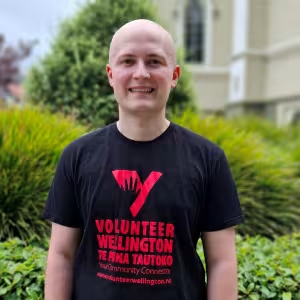
Photo by Karin Anderson
When NED TREACHER found himself at the end of a contract in the middle of a job vacancy drought, his partner suggested volunteering to keep occupied and involved. She had had rewarding experiences with Volunteer Hutt while at high school, so Ned contacted them. New to volunteering, he had nothing specific in mind beyond hoping to find something that would “keep [his] mind working” and to “work with others who are passionate about community and what they do”. His timing couldn’t have been better. The team had started developing a framework to ensure organisational compliance with its obligations under all relevant legislation and Te Tiriti, and suggested this as a project he could work on. It was, he said, “perfect”. With science policy training and experience with similar projects, he brought research and writing skills and a thirst to learn. He found both the passionate team and the rewarding project he was hoping for.
The project involved identifying and documenting where within the volunteer training, onboarding, and exit processes the team can make sure that everything that is being done is compliant with regulations, as well as with a Te ao framework. With employment law geared to an employer–employee relationship, he found it an interesting challenge to consider what did – and didn’t – apply in the volunteer context.
Considering the organisation’s obligations from a Te Ao perspective was a further opportunity to learn. He described the difference between the Te ao Māori approach, as he saw it, and Volunteer Wellington’s, as being bottom-up rather than top-down. Where Volunteer Wellington ‘provides’ volunteers to organisations much like providing workers for a ‘work’ environment, he said Māori organisations have a more community focus with their own volunteer networks of whānau and friends – it is a relationship rather than a transaction. He said there is a place for both styles and enjoyed considering both different perspectives on how the organisation could work and how to build a framework to support this.
With more experience on the “science side” of science policy, Ned also relished broadening his knowledge in a new context. He said Volunteer Wellington’s training exposed him to new information, particularly about Aotearoa New Zealand’s history, and the opportunity to visit local marae. When asked about challenges, he said it was “challenging in a really rewarding way” that inspired him to want to learn more. He said an important takeaway from the role was understanding the importance of ensuring that policy is responsive to the needs of Aotearoa New Zealand’s diverse communities, and what that actually means. In circumstances he describes as “bittersweet”, he has found employment and has not been available to be involved in the final, consultative, stage of developing the project. However, he is excited for the “new page” the project is turning for the organisation, and said he would absolutely volunteer again if he found himself between contracts in the future.